

Squares of Rome
Information on the places to visit in Rome, churches, piazzas and the attractions in Rome Italy from renowned Rome tour guide Dara McCarthy.
Squares of Rome
 Welcome to the Rome section of my website.
I created these pages out of tour notes I wrote about the city of Rome some years back.
I used to give walking and driving tours of the attractions of the Eternal City for 5 years.
Now I am back giving tours of my home town of Dublin, but I still have tour guide contacts in Italy.
If you are going to Rome and would like to take a walking or driving tour of the attractions in Rome you can send me a request here.
Attractions in Rome Italy
 Alternatively you can guide yourself around the city or just find out some info about Rome’s many piazzas and fountains.
Either if you take a tour or wander around by yourself, I hope this site is of some use to you.
Generally speaking Rome has had three bursts of building activity; Roman, Roman Catholic and Italian.
Rome Sites

Circa 500 BC to 475 AD
Most major buildings or squares in the city have Roman foundations or a history which explains their names or function.
The ancient Romans were originally a monarchy from 753 BC to 509 BC, the mythical Romulus founding the settlement around the Capitoline Hill and Forum.
The Romans booted out their last king Tarquinius Superbus in 509 BC and became a republic along the Greek model.
This form of government with regular elections would exist for over four hundred and fifty years.
Victorious generals and magistrates would commission buildings to honour their families and enshrine their name in the popular consciousness.
Examples include much of the Roman forum and Largo Argentina.
Rome Piazza
 Julius Caesar dismantled much the Roman Republic’s Constitution, concentrating power in his own hands as Dictator for Life.
His death in 44 BC at the hands of Brutus and Cassius lead to a civil war which Caesar’s great nephew Octavian won.
Octavian Caesar was given the title Augustus, the revered one, in 27 BC was Rome’s first Emperor in all but name.
In future all Roman leaders would call themselves Imperator Caesar Augustus and then their own name; Imperator, which means military general, is where we get the English word Emperor.
The emperors built many buildings around the city to ensure their names and those of their family would be remembered.
These include the Pantheon, much of the Roman Forum, the Colosseum, Piazza Navona, the theatre of Marcellus among many other buildings.
Attractions in Rome Italy
 Roman Catholic phase: Circa 800 AD to 1870 AD
After the fall of the Roman Empire in the west in 475 AD, about 1500 years ago, the Catholic Church became the effective rulers of the city.
They had been given substantial influence and grants by the Roman Emperor Constantine (308 to 333 AD) and on these lands built St. Peter’s Basilica, St. John the Lateran and St. Paul’s outside the Walls.
A future Emperor Theodosius made Christianity the state religion of the Empire (380 AD) meaning paganism was finished officially although it did continue for another 100 years or so.
Previous pagan temples were converted in to Roman Catholic Churches (the Pantheon, Santa Maria Sopra Minerva) and the Bishop of Rome or Pope (papa or father) carved out increasing influence as the head of the church in the West.
Things to do in Rome
 Constantine had moved the Roman Empire’s capital to the east renaming Byzantium to Constantinople (it’s now Istanbul).
It was still officially called the Roman Empire, but it was too far away to mount effective control over the city.
German warlords threatened Rome over the next 400 years until Pope Leo III made an alliance with the strongest tribe in Europe, the Franks (or future French) who were Roman Catholic.
Pepin the Short (Charlemagne’s father) gave the pope control over Rome and its surrounding regions which were now called the Papal States.
Pope Leo III cemented this alliance by crowning Charlemagne or Charles the Great in St. Peter’s on Christmas 800 AD.
The Frankish Empire would eventually be called the Holy Roman Empire and Rome was now part of the Papal States, which extended coast to coast and as far north as Bologna, dominating central Italy for the next thousand years.
Rome Fountain
 The second and most noticeable phase of building in the city now began in earnest.
From the years 1470 to 1770 the Popes would cause the creation of:
- the Campidoglio,
- Campo de’ Fiori,
- Jewish Ghetto,
- Piazza Barberini,
- Piazza del Popolo,
- Piazza Navona,
- Spanish Steps
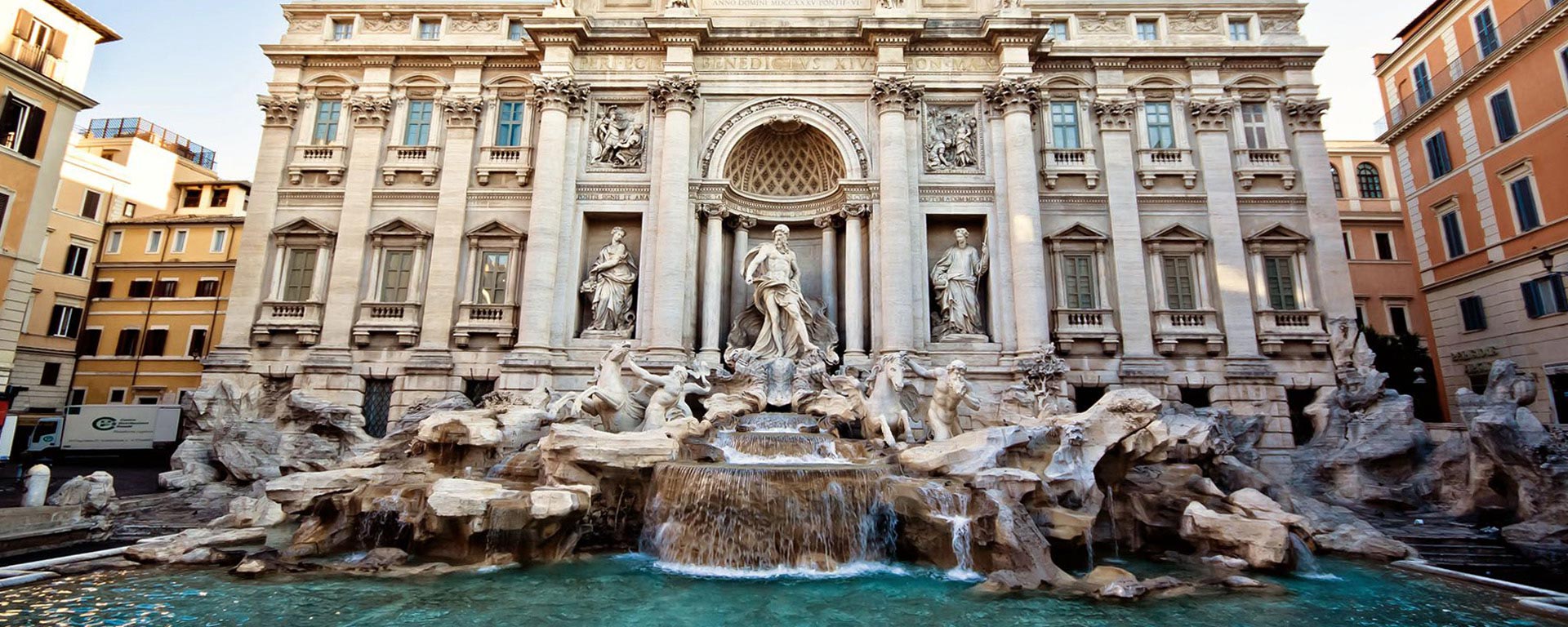
- Trevi Fountain.
Places to Visit in Rome
 Famous artists and architects during this period include Michelangelo, Raphael Sanzio, Leonardo da Vinci, Gian Lorenzo Bernini, Giacomo della Porta, Giuseppe Valadier among others.
The Catholic Church was directly involved in promoting the Renaissance and the Baroque artistic periods.
Rome Vacation
 Italian phase: 1870 AD –
In 1870 the city states of Italy unified in to the country we basically know today.
The Papal States were seized and Rome became the capital of the new country.
The new state, cleared the Roman Forum and opened it to the public, renovated other buildings and created Il Vittoriano which is the white wedding cake shaped building on Piazza Venezia.
In the 1920s Mussolini took power in Italy and went about glorifying the city, completing Michelangelo’s floor design on the Campidoglio, and creating two major roads that provide scenic views; Via dei Fori Imperiali lining the Colosseum to Piazza Venezia and Via Conciliazione linking St. Peter’s to Castel Sant Angelo. He is still criticised by archaeologists and historians to this day for destroying or covering up ancient Roman ruins.
Mussolini was killed during the Second World War (1939 to 1945) and Italy had a constitutional referendum to abolish the monarchy shortly afterwards.
It is now a democratic republic with a president as head of state.
The state carries out restorations of the city’s monuments on a regular basis and new finds are still being made in excavations which causes delays in the delivery of infrastructure problems and the ire of the Italians.
Best of Rome Tour
 If you would like to take a best of Rome tour, where you choose which sites you would like to see you can email me via this section of my website and I can organise one of my guide friends who lives in Rome to show you around.
3 hour Walking Tour of the Piazzas and Fountains of Rome Italy
Rated 5.0/5 based on a selection 10 customer reviews out of thousands.